Surprising stat to start: a single modern exchange interface now bundles centralized order books, an on‑chain proof of reserves, a self‑custodial Web3 wallet, and cross‑chain DEX routing — and that combination changes the decisions traders must make. OKX exemplifies this shift. For a US-based trader who wants speed, derivatives access, and a direct line to DeFi without leaving a single platform, OKX offers a rare mix of tools. But that convenience also creates new operational trade-offs and failure modes that a smart trader needs to understand before logging in or moving capital.
This piece uses a concrete case — a US retail trader who wants to: (1) access spot and margin markets, (2) use perpetuals or options from time to time, and (3) hold some assets in a Web3 wallet for yield or DApp use — to explain how OKX stitches centralized and decentralized workflows together, where the boundaries blur, and what to watch for when you click through to sign in.
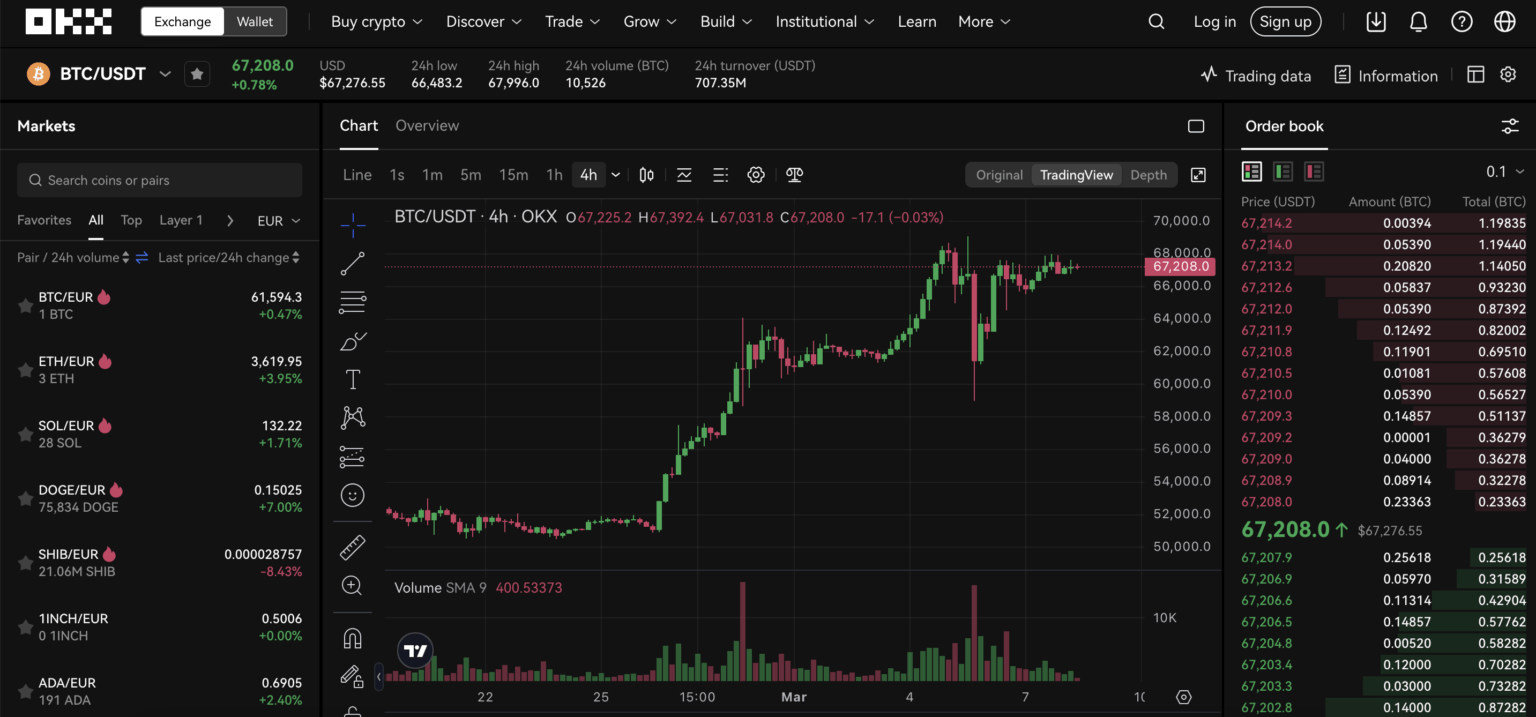
How OKX Layers Work: CEX, Web3 Wallet, and DEX Aggregator — Mechanisms, Not Buzzwords
Mechanism matters because the user experience masks distinct custody and execution models. At the core: OKX operates a centralized exchange (CEX) with order books and matching engines, plus a non‑custodial Web3 wallet that holds private keys and can connect to DApps. These are separate legal and technical domains even when the UI presents them as one. Understanding how assets move between them — and what remains under your control — is essential.
On the CEX side, OKX supports spot trading, margin borrowing (up to about 10x in isolated or cross‑margin), and a derivatives suite including perpetual swaps and quarterly futures with leverage that can reach 125x on certain instruments. Execution on that side is fast and capital‑efficient: you deposit fiat or crypto into your exchange account, margin is handled internally, and the exchange enforces liquidation rules. The trade‑off: your positions are subject to the exchange’s risk engine, and access depends on KYC completion and regional regulatory constraints.
On the Web3 side, OKX’s wallet is non‑custodial: you hold the seed phrase (unless you link a hardware device), and the wallet can connect to thousands of DApps and chains. That means you control private keys — a necessary condition for interacting with DeFi — but also bear singular responsibility for backup and recovery. The practical boundary: funds in the Web3 wallet are not covered by the exchange’s cold‑storage protections or insured in the way funds held on the CEX might be.
Case Walkthrough: A US Trader’s Session — From Login to Cross‑Chain Swap
Imagine you open your laptop, want to move quickly between a margin BTC short, a small options hedge, and a cross‑chain swap to bridge some USDC to Solana for a DeFi farm. The typical OKX workflow looks like this: you sign in to the CEX portion (KYC completed), check your exchange wallet balances, execute the BTC trade using TradingView charts and the exchange order book, and then either withdraw to your non‑custodial OKX Web3 wallet or use an internal transfer if the platform supports it. For a Web3-only action, you connect the browser extension and approve transactions with your seed or hardware wallet.
Two operational mechanisms to note: (1) internal transfers between CEX account and OKX Web3 wallet are faster and cheaper than on‑chain withdrawals because they can be settled within OKX’s internal ledger; (2) the DEX aggregator sources liquidity across multiple AMMs and blockchains to find better swap routes, but each cross‑chain bridge step introduces smart contract and bridge counterparty risk. That last point is the practical cost of convenience: lower fees and faster UX can hide incremental protocol risk.
If you’re ready to perform that login, use the platform’s official sign-in route to reduce phishing risk: okx sign in. Use that only as part of a larger hygiene routine: confirm the domain, enable 2FA, and avoid copying seed phrases into web forms.
Security Architecture: Cold Storage, PoR, and Remaining Vulnerabilities
OKX’s security model mixes centralized and user‑centric protections. More than 95% of exchange‑custodied assets are kept in air‑gapped cold storage, typically protected by multi‑signature approvals. That materially reduces the risk of hot‑wallet exploits draining the platform. In addition, OKX publishes Proof of Reserves (PoR) so users can verify the platform’s asset backing on‑chain — a transparency mechanism that helps address the classic “fractional reserve” worry.
Nonetheless, several limitations persist. PoR proves backing at a snapshot in time but does not eliminate operational risk, nor does it substitute for a formal insurance policy covering all loss scenarios. Separately, the non‑custodial Web3 wallet shifts custody risk to the user: lost seed phrases mean permanent loss. And the single largest real‑world threat for most users remains phishing and social engineering; military‑grade encryption and AI‑driven login threat detection reduce such incidents but cannot prevent a user from pasting a seed phrase into a malicious page.
Trading Mechanics and Risk Trade‑offs
For derivatives traders, leverage is the primary lever of power and danger. OKX’s up‑to‑125x leverage is attractive for capital efficiency but exponentially increases liquidation risk: small adverse moves can wipe equity. The exchange’s margin and liquidation algorithms aim to protect the platform and other users, but they do so at the individual’s expense when volatility spikes. A practical heuristic: treat high leverage for tactical, time‑bound trades only, and size positions so the liquidation price is outside routine intraday volatility.
Spot and margin trading are simpler mechanically but still subject to slippage and liquidity constraints — especially after platform delistings. For example, OKX recently delisted several spot pairs (RSS3, MemeFi, GHST, RIO, SWEAT). That routine pruning matters because it changes the available liquidity universe: delisting reduces execution venues for niche tokens and can widen spreads for related assets. For a trader, it means monitoring exchange listings is part of risk management: when a pair is delisted, you may need to withdraw to a self‑custodial wallet or find another venue, incurring fees and timing risk.
Where OKX’s Integrated Model Helps — and Where It Breaks
Strengths: unified UI reduces context switching, internal transfers accelerate movement between trading and Web3 activity, and broad blockchain support (130+ chains) lowers friction for cross‑chain strategies. For US traders who must juggle tax reporting, KYC, and bank rails, having fiat onramps and regulated compliance on a single platform simplifies bookkeeping and audit trails.
Limits: regulatory dynamics can change access and product availability in the US. KYC is required, which is good for compliance but reduces anonymity. Cross‑chain and DeFi exposures bring smart contract risk that regulation does not mitigate. Finally, the convenience of a single platform can create concentration risk: if OKX experiences an outage or restricts withdrawals, a trader with everything in one place can face acute illiquidity.
Decision Framework: A Simple Heuristic for Using OKX Effectively
Here is a practical four‑step heuristic I recommend:
1) Segregate capital by role. Keep a margin/trading bankroll on the CEX sized for active positions; keep long‑term holdings in the Web3 wallet or hardware wallet. That limits liquidation contagion.
2) Use leverage only for defined timeboxes. If you enter a 25x position, set strict stop limits and treat it like a short‑term trade, not a buy‑and‑hold.
3) Confirm bridging and DEX routes before committing large sums. Review expected fees, bridge counterparties, and slippage tolerance — and test with small amounts.
4) Harden login and recovery. Use hardware keys where possible, enable biometric or app‑based 2FA, verify domains, and store seed phrases offline in multiple secure locations.
What To Watch Next — Signals That Matter
Three near‑term signals matter to US traders: regulatory guidance affecting derivatives access; further delistings that change liquidity in niche tokens; and advances in bridging security (e.g., multisig or pooled insurance models) that reduce counterparty risk in cross‑chain swaps. Each signal affects different decisions: regulatory shifts alter which products you can legally use; delistings change where to keep particular tokens; and bridge security upgrades change how large a cross‑chain transfer you are comfortable making in a single hop.
All predictions here are conditional: stronger bridge security would make integrated CEX→Web3 workflows safer in practice, but regulatory constraints or market shocks could simultaneously limit on‑ramps or derivatives leverage. The intelligent trader monitors both protocol safety signals and policy developments in tandem.
FAQ
Is OKX safe for US traders?
“Safe” is multi‑dimensional. OKX uses industry practices like 95% cold storage, multi‑sig, PoR, and AI threat detection for logins, which materially reduce exchange risk. However, safety also depends on user behavior: KYC visibility, phishing avoidance, and seed phrase custody matter. For custody of long‑term savings, many US traders prefer hardware wallets; for active trading, holding some capital on a regulated exchange for speed and product access is reasonable if you follow strong hygiene.
Can I use OKX’s Web3 wallet and the exchange from the same account?
Yes. The UI integrates both, but they represent different custody models. The exchange side holds assets under OKX’s control; the Web3 wallet is non‑custodial, where you control private keys. Internal transfers may be faster than on‑chain withdrawals, but moving assets off the exchange into your own wallet is the only way to take full custody.
What should I do before using leverage on OKX?
Understand the margin model (isolated vs cross), set position sizes that limit liquidation risk, use stop orders, and stress‑test scenarios (e.g., 10–20% adverse move). Remember higher leverage amplifies both gains and losses and can liquidate capital rapidly during volatility.
How does Proof of Reserves help me?
PoR lets you verify on‑chain that the exchange holds assets corresponding to user deposits at a snapshot in time. It increases transparency but doesn’t insure against every operational failure or future liabilities. Treat PoR as a trust‑enhancing signal, not a complete safeguard.
What are the main risks when using the OKX DEX aggregator?
Aggregator routing can reduce slippage by finding liquidity across AMMs, but each route may touch multiple contracts and bridges, introducing smart‑contract and counterparty risk. Always check estimated slippage, the number of hops, and bridge security practices before approving large swaps.